
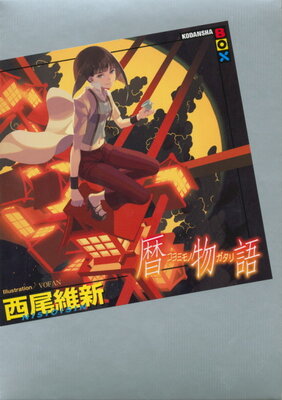
How far does one go to help a lost child? In the case of returning narrator Araragi, the answer is too far, across the veil of time. Dutifully (if unknowingly) following up on Hachikuji’s cheeky foreshadowing, he concerns himself with his young lady friend and her fate in this instalment of the cult-hit series, heroically unable, once again, to find his own way home. Thus the tale is also, or more so, about the journey itself, the dark honeymoon of a trip he takes into the past with the dweller in his shadow, Shinobu. Even among a cast that routinely disrespects chronology with their meta-commentary, she takes the cake, or the doughnut, by rewinding the clock for a perverse road movie, one that by and large goes nowhere, spatially. It’s Kabuki not as in the theatre, but with the character for “tilt”—as in a slanted attitude toward the world, the posture of a bohemian. Or, perhaps, of a legendary vampire who once sought death, and of a high school senior who once tuned out life doing their dandy best to attend to an embarrassing wealth of aberrations in a provincial town. (Source: Kodansha USA)
Japanese study overview
Kabukimonogatari is a Japanese novel of 180,842 characters, with 8,133 unique words and 1,716 different kanji. Its difficulty rating on Jiten is hard, 3.2 out of 5. The full vocabulary list ranks all 8,133 words by how often they appear, and you can study them on Jiten or download them as an Anki deck.










Vocabulary highlights
Here are some of the words that appear most often in this media, as well as a sample of its rarer vocabulary.
- 僕I×1,035
- 言うto say×606
- 忍stealth×440
- お前you×392
- 思うto think×331
- 世界the world×253
- 儂I×243
- 八九寺Hachikuji×241
- 吸血鬼vampire×172
- 彼女she×162
- 様Mr×158
- 前in front (of)×155
- お前様you×106
- 羽川Ukawa×103
- 忍Azumi×83
- 阿良々木Araragi×75
- 斧乃木Ononogi×65
- 母の日Mother's Day (2nd Sunday of May)×28
- 白蛇albino Japanese rat snake×23
- 学習塾cram school×14