Choosing media at your level
How to read difficulty scores, coverage and pick media you can enjoy.
Updated
When you're just starting to learn Japanese, choosing what to read can be a challenge. Jiten offers many tools to help make this choice easier. The essential thing to remember is that your motivation to consume a title is more important than any score. If you think you'll enjoy it, then try it even if the difficulty seems higher than what you're used to.
Difficulty score
Every title has an algorithm difficulty score from a model trained on Japanese text. You should treat it as a way to compare titles approximately rather than a universal source of truth. Additionally, users can vote on difficulty scores: ▲ means readers voted it harder than the algorithm thinks, ▼ easier (doubled arrows for a big gap), and ≈ means votes confirm the algorithmic difficulty.
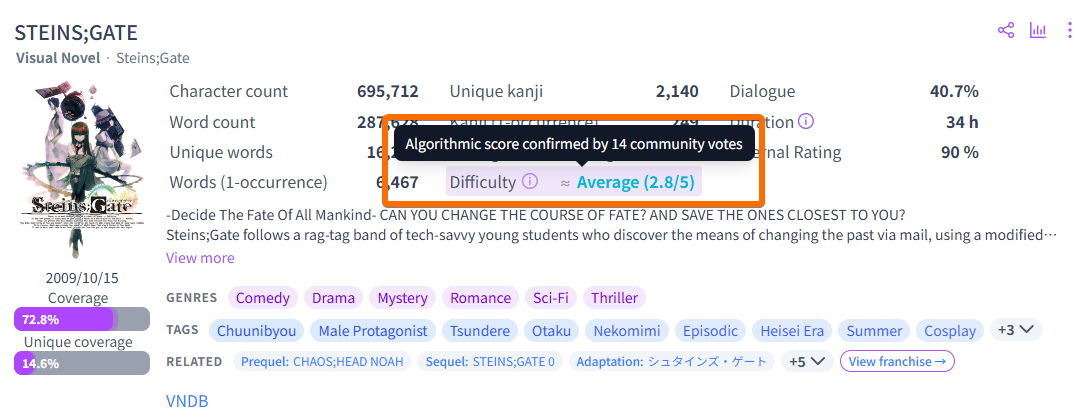
Coverage, your personalised metric
The coverage is the percentage of words you know in total in a media. There are no hard rules about how much coverage you should aim for, 80% will be about 2 lookups per sentence, 90% a single one, 98% a lookup or less per page. Find a balance that you're comfortable with, depending on how much you're willing to look up and your tolerance for ambiguity.
Your coverage depends on your known words, you can find out more at tracking what you know.
Length: character and word counts
Another metric to take into account is the length of a work. For novels, you'll be looking at the character count, and you can see an estimate of your reading time after setting up your reading speed in the quick settings menu (cog at the top-right). The recommendation is to not start with something too long, as the act of finishing a work will keep you motivated.
On the other hand, longer works become easier as you keep reading them as you get familiar with the vocabulary and grammar used by the author.
Putting it together
None of these metrics decide for you on their own, they're just there to guide your expectations and help you choose something appropriate. A practical way to weigh them together:
- Start from motivation. Filter the Media browser to a type and genre you actually want to read. A title you're excited about will carry you through a rough patch that a "correct" but boring pick never would.
- Use difficulty to narrow, not to rank. Sort by difficulty and look at the band slightly below your level and slightly above.
- Check coverage on your shortlist. Open a few candidates and see your personal coverage. Higher coverage means fewer lookups and more flow; lower coverage means more work but faster vocabulary growth. Pick the trade-off you're in the mood for right now.
- Let length break the tie. Between two similar options, the shorter one wins for a first read, finishing something is worth more motivation than any score. Once you've found an author or series you like, lean into their longer works, they get easier as you go.
Rule of thumb: for an early pick, aim for at least 80% coverage on the shortest title you're genuinely excited to read, and adjust from there once you know your own tolerance for lookups.
There's no single "right" number. If you finish something and it felt too easy, push the difficulty or drop the coverage a little on your next pick; if it was too difficult, do the opposite. It's also okay to take a breather with something easier, remember to have fun!